Getting Started With
Roses (or
"Seven Steps to Addiction")
 All of
us began this "pursuit of the rose" somewhere, but for those who
only know a rose as the cut flower from the florist, we realize our web
catalog can be somewhat overwhelming. So...if you'd like to try growing
some roses in your garden, but don't know where to start, this page is
for
you. We will give you step by step instructions to help you determine
which roses are right
for your situation. Following the steps in order
will
narrow the field as you go, but you'll still have to do some research
on
your own, either in personal visits to rose gardens, or via books,
catalogs or the internet. Since our availability for consulting
is limited
we highly recommend that you join your local chapter of the
American Rose Society
or the Heritage
Roses
Group in order to
learn from others who are further along the journey and happy
to help. We have yet to meet any
rose grower who does not enjoy talking
about his or her own experience with the Queen of Flowers!
All of
us began this "pursuit of the rose" somewhere, but for those who
only know a rose as the cut flower from the florist, we realize our web
catalog can be somewhat overwhelming. So...if you'd like to try growing
some roses in your garden, but don't know where to start, this page is
for
you. We will give you step by step instructions to help you determine
which roses are right
for your situation. Following the steps in order
will
narrow the field as you go, but you'll still have to do some research
on
your own, either in personal visits to rose gardens, or via books,
catalogs or the internet. Since our availability for consulting
is limited
we highly recommend that you join your local chapter of the
American Rose Society
or the Heritage
Roses
Group in order to
learn from others who are further along the journey and happy
to help. We have yet to meet any
rose grower who does not enjoy talking
about his or her own experience with the Queen of Flowers!
Step 1: Know your Agricultural Zone.
Click on our link here to
determine your
zone. This chart is based on your
average lowest winter temperatures, and since different classes or
varieties of roses survive different winter conditions it's necessary
to
know this information so you won't buy a plant that won't live past
your
first year (unless you're willing to grow them as annuals, as some
people do). You can also use this link to go to Garden
Web's zone finder
that asks for your zip code.
 Step 2: Know
Your Sun Exposure.
Step 2: Know
Your Sun Exposure.
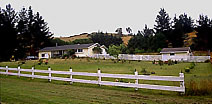
Study the area where you want to grow roses and determine how much
sun
will shine there during your growing season. Most roses love the sun
and
prefer full sun for a minimum of 4 to 6 hours a day to bloom well. If
your
area will get less than 4 hours of full sun then you'll have to
restrict your
choices to "shade tolerant" varieties. Hybrid
Musks and some of the once
blooming Old Garden Roses and Species
do OK, with less than optimum sun. Also blooms
with fewer petals can be coaxed to open with less sun and heat, like
Mutabilis, a China rose: 
No rose will grow and bloom in
total shade or indoors. The only kind
of
rose for those situations is one in a vase.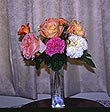
 Step 3: Know Your
Planting Area and Growth
Habit Preference.
Step 3: Know Your
Planting Area and Growth
Habit Preference.
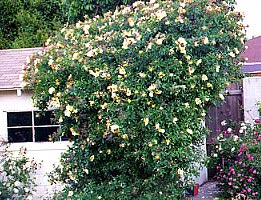
Decide how large a space you want to plant with roses, and how tall
you
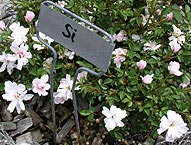
want those roses to be. Roses come in sizes that vary from the smallest
rose in the world (5-inch Micro
Miniature Si, left) to a
30-foot Climber (Mermaid,
below). Approximate height by width size at maturity (e.g. 4 x 3 ft.)
of each
variety will determine how many plants you can put into your available
space. Also, knowing the growth habit of each variety (rambler,
upright,
mounded, weeping, shrubby, etc.) will help determine what kinds of
roses
will provide the look you want in your garden.
 Step 4:
Know Your Flower
Preferences.
Step 4:
Know Your Flower
Preferences.
Rose flowers come in a wide range of sizes, colors, bloom form,
bloom
habit, and fragrance. The more you know about what you want, the easier
it is to locate it in the 10,000+ rose varieties in commerce today.
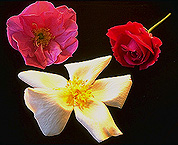
Rose
blooms with 4 - 12 petals are called Singles, then there are Nearly
Single,
Nearly Double, Double, Fully Double, Loose, Pompon, Quartered, Flat,
etc. Pictured at left, from the top left going clockwise, are Delicata
(Hybrid
Rugosa), Grüß an Teplitz (China),
and Nevada (Shrub).
The "typical florist rose look" is described as "Double and High
Centered"
and found mostly in the Hybrid Tea and Grandiflora classes of roses.
Here's Fire 'n' Ice, a
Floribunda/Hybrid Tea,
demonstrating the high-centered and
double petaled side view: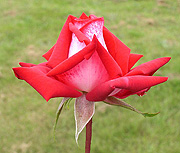
Other questions to consider:
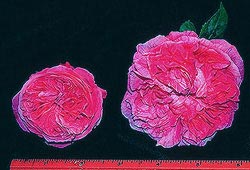
What size blooms do you want? Nearly all rose flowers are between 1 and
5 inches in diameter. Typically the first blooms of the year on
repeating
varieties will be the largest with summer heat stress reducing the size
in
the next bloom cycle. Shown here: Louise Odier on left
(Bourbon), La
Reine (Hybrid Perpetual) on
right.
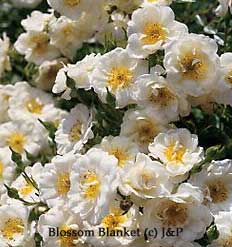
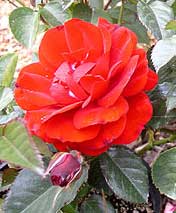
Additionally, small 1" to 2"
flowers are found in not just the Miniature,
but also the Groundcover, Floribunda, Polyantha, and Species
classes. Here's Blossom Blanket, a Groundcover, and Showbiz,
a Floribunda:
 How
important is
fragrance and what type of fragrance
(fruity, myrrh, rose, tea, strong, damask, clove, musk)?
How
important is
fragrance and what type of fragrance
(fruity, myrrh, rose, tea, strong, damask, clove, musk)?
Do you want the
plant to rebloom all
season long or have just one huge flush of flowers for up to 6 weeks
(noted as "non-recurrent","once a year bloomers", or "one annual
bloom")?
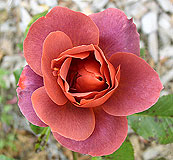 What
colors or shades of color are preferred? How about
striped or bi-colored blooms? Keep in mind that light quality and
weather will have an effect on the bloom colors of your roses,
especially ones like Hot Cocoa, left, and Double Delight, here:
What
colors or shades of color are preferred? How about
striped or bi-colored blooms? Keep in mind that light quality and
weather will have an effect on the bloom colors of your roses,
especially ones like Hot Cocoa, left, and Double Delight, here: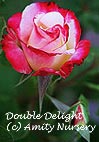
 Are stiff, long,
upright stems important or is
a nodding flower just as pretty? At left is the Old Garden Rose, Grandmother's Hat.
Are stiff, long,
upright stems important or is
a nodding flower just as pretty? At left is the Old Garden Rose, Grandmother's Hat.
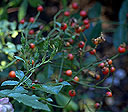 Would you like hips
or colorful foliage for fall
color? Most Species and Hybrid Rugosa roses are well-known for
their
hips. This photo is of Ballerina, a Hybrid
Musk.
Would you like hips
or colorful foliage for fall
color? Most Species and Hybrid Rugosa roses are well-known for
their
hips. This photo is of Ballerina, a Hybrid
Musk.
Do you want to plant own-root
roses or
grafted
rose
varieties?
Step 5: Know Your Tolerance for
Disease
Some roses are highly disease prone and will not do well in certain
climatic conditions without preventative measures. Other varieties are
easy to grow and look healthy or OK without much effort most of the
year. Ask yourself if you are willing to spray your roses with either
organic or
non-organic products on a regular basis (typically every 7-10 days) in
order to have good-looking roses. If not, then talk to other rose
growers
in your area to determine which rose diseases (powdery mildew, black
spot, rust, downey mildew) are prevalent in your climate and then look
for
varieties of roses that are resistant to those particular problems.
Also,
proper sun exposure and good air circulation will help reduce disease
problems, so keep that in mind when picking out the spot you want to
plant
(i.e. In the Northern Hemisphere, any rose planted in the north-facing
corner of a high solid fence is just asking for trouble because of the
lack
of sunlight and air circulation.)
Step 6: Know What Roses are
Available Where
Armed with the above list of preferences you are now better
prepared to
shop. Check out some rose books from the library, take a stroll at a
local
nursery or rose garden, meet that neighbor who grows the one you want
to
have, talk to fellow rose group members, or spend some time on-line
enjoying the many rose websites available, including www.HelpMeFind.com/roses .
No one
place will answer all of your questions so get used to the idea
of researching multiple sources, along with getting some real
trial and error experience in your own garden. It's all part of the
process that makes rose growing such a fascinating and rewarding hobby.
Step 7: It's Time to Commit
At this point you're ready to find mailorder suppliers for the roses
you
want to grow, or you can buy what's available at your local nursery.
Depending on your zone and when you can work your garden soil, you can
purchase dormant bareroot roses January-May or purchase plants shipped
year round in pots of planting mix. Contact your mailorder
nurseries early for the best selection as most take pre-orders for
plants
to be shipped later at your proper planting time.
However you go about deciding what
rose varieties you want to grow
we
wish you a most happy journey!

Copyright
© 1997-2013 Amity
Heritage Roses/Amity Rose & Garden Nursery™.
All Rights Reserved.
Most of the images on this site have been reduced in quality to
save
bandwidth.
Both they and their
full-sized, high quality originals remain the
property of their
creators.
They are
copyright protected and
may not be snatched, copied, duplicated,
reproduced
or otherwise fiddled with
without prior written consent.